
How to Search for a Warrant in Hawaii County
Begin at the Hawaiʻi Judiciary's Search Court Records page and enter eCourt Kōkua. It covers public case information from District, Circuit, and adult criminal Family Court matters, among other case types. It is a case-search service, not a live warrant roster. A docket may contain a warrant-related event, motion, or order, but the issuing court must confirm its present effect.
Gather the full legal name, the correct court division, and any case ID or citation number already available. A name match alone does not establish identity. When an entry may concern you, use the case number and signed documents to verify it, then ask the court or a licensed attorney how to proceed safely.
Choose the search path by the record already in hand. A citation number belongs in case search, while a plate or VIN belongs in vehicle search. Upcoming-hearing search may help locate a scheduled event. Once a case appears, note the court, division, filing year, docket sequence, and latest public action. Those details help the clerk locate the same record and reduce the risk that a similar name leads to the wrong file.
- Open eCourt Kōkua from the Judiciary records page and choose party, case, citation, vehicle, or hearing search as the known facts allow.
- Use exact party details or, preferably, the case ID or citation number. For a Third Circuit case, check that the identifier begins with circuit digit 3.
- Read the docket and available public order. Do not treat ACTIVE or INACTIVE case status as a warrant-status label.
- If the public file is incomplete, request the record from the Hilo or Kona Legal Documents Branch or contact the relevant District Court office.
- For a police-held record, use HPD's records or UIPA process. Ask the issuing court or counsel to confirm current status before acting.
Hawaii County's Public and Protected Systems
Two Judiciary systems serve different users. eCourt Kōkua is the public route for case and document research. eBench Warrant is a protected statewide application for approved law-enforcement and criminal-justice agencies. The official eBench Warrant page says the system covers traffic, criminal, and non-Family civil warrants and is updated several times daily, but the public cannot sign in.
The manifest capture of the Judiciary court-records landing page shows the official public starting point.
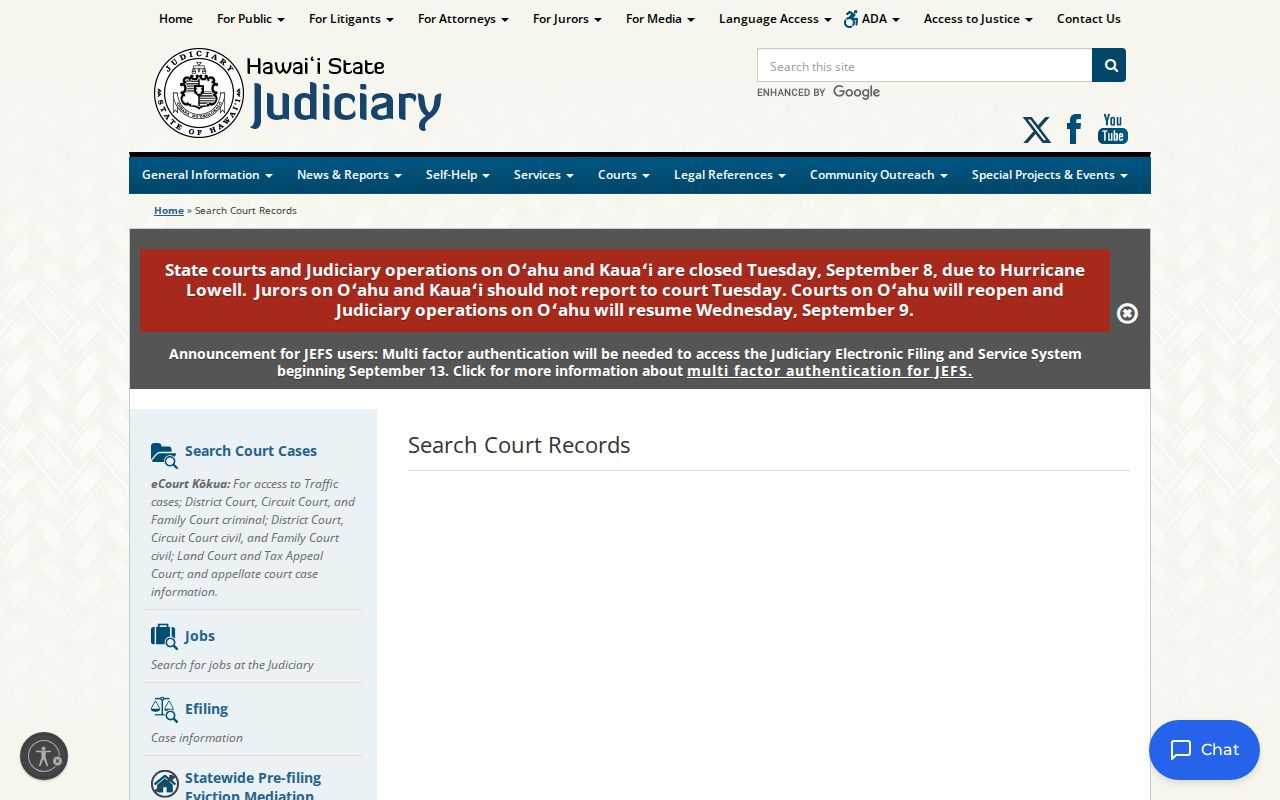
This public entry route leads to case information and documents, not to the protected agency warrant database.
Access boundary:
A public docket search can reveal warrant-related activity, while only an authorized agency query or the issuing court can confirm the operational record.
Hawaii County also has no separate county sheriff warrant portal. HPD is the primary county law-enforcement agency, and no complete public HPD roster was found. That makes court-first verification especially important.
The systems answer different questions. eCourt Kōkua can show a public warrant-related event, recall motion, or order, but it cannot expose sealed material or guarantee that an agency record has synchronized. eBench Warrant helps approved agencies act on statewide records. HPD notices cover selected matters, while an HPD records request concerns existing police records that can lawfully be released. A reliable search keeps these limits visible instead of blending the channels into one supposed database.
Hawaii County Warrant Search Fields
The 2026 eCourt Kōkua user manual documents several ways to locate a case. Person search requires last and first name, with optional middle name, phonetic and partial-match controls, a filing-date range, and case type. Case search accepts a case ID or citation number. Vehicle search uses a plate or VIN. None of these public fields directly asks for a warrant number.
| Field Label | Type | Required | Notes |
|---|---|---|---|
| Last Name | Text | Yes | Partial and phonetic controls may broaden matching. |
| First Name | Text | Yes | Use the full legal first name when known. |
| Middle Name | Text | No | Helps separate similar names but does not prove identity. |
| Case ID or Citation | Text | No | Used in a separate case-search route and usually gives a more exact result. |
| Case Type and Dates | Choice/date | No | Narrows results by filing period and type of case. |
Date ranges and case types make a broad name search more manageable. Phonetic matching can help when spelling varies, while partial matching widens the result set. Both controls create more candidates to check. The fields support discovery, not positive identity. Exact case identifiers remain the strongest public key. If paperwork from a hearing, citation, or prior filing is available, copying that number exactly is more useful than repeatedly widening a party-name search.
Reading Third Circuit Case Numbers
Third Circuit case identifiers begin with the circuit digit 3. Current IDs combine that digit with a court indicator, two-letter case type, two-digit year, and sequence. Older migrated cases can require a 12-character form. For example, the Judiciary explains that a displayed ID such as 3PC-15-1-123 may be entered as 3PC151000123.
Use the exact identifier shown by the court. A citation number, case ID, and warrant number are not interchangeable. If an older file does not appear, the Judiciary's system-availability instructions and records help desk can clarify the required format. This exact-number route avoids many of the false matches created by broad name searches.
A case number also helps route follow-up. Circuit and District matters have different clerk functions within the Third Circuit. An old number may have migrated from a prior system, so punctuation on paper can differ from what the online form expects. Keep both versions when contacting staff. Do not derive a warrant number from a case sequence. One file can contain several warrant-related motions, returns, and orders, each with its own date and effect.
What a Hawaii County Warrant Search Returns
A public result can show case and party information, the court and judge, case status, docket entries, hearing details, and available public documents. A warrant may appear only as a docket code, motion, or signed order. Read the entry in context and compare it with the latest order. The public page does not promise a dedicated current-warrant field.
| Case ID | Third Circuit identifier, such as the redacted format 3PC-25-1-000, used to track the court file. |
|---|---|
| Docket event | May include a warrant-related code, motion, filed order, or return. |
| Issuing court | Identifies the Circuit, District, or other division that controls the case. |
| Hearing information | Shows public dates, times, and locations when available. |
| Case status | ACTIVE, INACTIVE, or a closing code describes the case, not necessarily a live warrant. |
Bail information needs equal care. A figure on a warrant form is case-specific and does not establish that online payment will resolve the order. Some cases require an appearance or judicial review. A docket event labeled MRBW shows that a motion to recall was filed, not that it was granted. Look for the later order. If the document is unavailable, request it from the branch maintaining the file rather than infer the result from an abbreviation.
Hawaii County Status Codes Need Context
The Judiciary warns that public case labels must not be read as warrant conclusions. ACTIVE means a case is ongoing. INACTIVE can describe a pending case with no current action until a later event, and the official FAQ includes a failure-to-appear or bench-warrant setting as an example. CLOSEDJ and CLOSEDS describe different kinds of closure.
- MRBW
- Motion to recall a bench warrant. Filing does not prove the judge granted it.
- MQSH
- Motion to quash. The signed order controls.
- OSEL
- Order sealed or confidential, so the public document may be unavailable.
- PCAW
- Probable cause to issue an arrest warrant, not a public live-status promise.
Check the date and disposition of each filing. A motion, payment, or case-status change does not by itself establish that the warrant was recalled and synchronized with agency systems.
Other codes can flag related issues without answering the warrant question. CBF means court bail forfeited. OLS is a driver's-license stopper, while OLC and OLCI concern stopper clearance. A stopper can follow a traffic failure, but it is not itself an arrest warrant. NTA means notice to appear, and NTI means notice of traffic infraction. Read each code within the full sequence, then confirm the current order with the court.
Where Hawaii County Warrants Are Checked
The Circuit Court of the Third Circuit handles felony and other circuit-level matters. The District Court of the Third Circuit handles misdemeanors, traffic, and county-ordinance matters. Family Court records follow stronger access limits. Hawaiʻi County has no incorporated cities or municipal courts, so there is no separate city-court warrant list to search.
For files maintained on the east side, the Hilo Legal Documents Branch is a key record contact. Kona maintains a separate branch, while Waimea/South Kohala District Court is another routing point. HPD executes and investigates within its authority, but the issuing state court controls its order. Approved agencies consult the statewide protected eBench Warrant system.
Geography affects access. A Hilo case may be maintained through Hilo Hale Kaulike, while a Kona matter may belong with the Kona branch. Waimea/South Kohala provides another District Court route. Before traveling, use the Third Circuit directory to confirm the office and whether the question concerns Circuit documents, District criminal or traffic records, or Family Court. HPD can route police questions, but it cannot replace the clerk's confirmation of a judicial order.
Requesting Hawaii County Court Records
When the online docket lacks the needed document, use the Judiciary's neighbor-island court-record request process. Send the request to the branch that maintains the case. Identify the Third Circuit division, case ID or citation, document type, and an approximate date. An incomplete request can delay the search.
Do not send money with the first request. The court sends an invoice that includes return postage, and the instructions call for prepayment by money order, cashier's check, or certified check. Confidential material can require court approval. For police-held operational records, a separate UIPA request should identify an existing HPD record rather than ask the agency to create a new active-warrant compilation.
The Hilo and Kona Legal Documents Branches serve different records and locations. Contact the branch first if the file's location is uncertain, especially when travel across the island would be required.
For UIPA, describe an existing record with a date range, agency, and format. Hawaiʻi law does not require the agency to create a new list or answer a research question. A narrow request for a public procedure, known operation summary, or identified report is more workable than a demand for every record about a private person. Ask for segregable redacted portions when a document mixes public and protected facts.
The court and police processes should not be swapped. A request for a filed order, docket document, or certified court record belongs with the court that maintains the case. A request for an existing HPD policy, operation report, or police-held record belongs with HPD. The Office of Information Practices says a requester need not explain why the record is wanted, but the description must be reasonable enough for the agency to locate it. State administrative rules describe notice and timing, while lawful fees, redaction, confidentiality review, and prepayment can affect delivery.
Public courthouse terminals may offer a practical alternative when online document access has a charge or when help is needed with the interface. The Judiciary records page lists system hours and a records help contact, but hours and prices can change. Confirm them on the live official page before a visit or purchase. If the goal is only to learn whether the latest order recalled a warrant, requesting that named order is more focused than buying every document in a long case file.
Access and Restricted Warrants
The Uniform Information Practices Act, HRS Chapter 92F, generally favors access to government records, but it does not turn protected live databases into public search tools. Privacy, confidential investigations, criminal-history restrictions, sealed orders, juvenile matters, and security needs can limit or delay disclosure. An agency may release segregable, redacted portions when the rest is protected.
Key Rules:
Sealed or confidential orders and documents do not appear in ordinary public results.
Juvenile and some Family Court records have added confidentiality protections under Hawaiʻi law.
Absence from eCourt Kōkua or an HPD notice is not proof that no warrant exists.
Family Court requires added caution. Adult criminal access does not automatically extend to juvenile or confidential family matters. The JJIS warrant-summary model documents fields such as circuit, issue date, status, service date, and agency, but that model is not permission to publish a person-level list. Contact the proper Family Court branch about authorized access, and avoid copying private identifiers from any form or record.
A missing public PDF can have several explanations. The document may be sealed, confidential, unavailable for online purchase, recently filed, or retained in a format that requires a clerk request. It may also be part of a Family Court file with stricter access. State and county agencies can withhold material under applicable privacy, investigative, security, and confidentiality provisions. Ask whether a redacted version is available, and do not treat the access decision as evidence that a warrant either exists or does not exist.
Verify Hawaii County Warrant Calls
HPD has warned about callers who claim a missed court date or warrant, spoof official-looking caller identification, and demand immediate payment. A frightening call is a reason to slow down and verify, not to follow an unsolicited payment route. End the call, find the court or HPD contact on an official website, and place a new call yourself.
Payment warning:
HPD does not direct people to clear warrants through gift cards, Bitcoin, Coinstar, or funds sent to an unknown caller.
Use the case ID or citation to ask the issuing court what its docket shows. If a threat creates an immediate safety concern, use HPD's official emergency or non-emergency channel. A court clerk or attorney can explain the proper appearance, recall, quash, or bail process without relying on the caller's claims.
Real resolution is a court process. It can involve an appearance, a motion to recall or quash, bail review, surrender, or compliance with another order. Paying a fine does not automatically prove a bench warrant was recalled. A hearing reminder also does not excuse a missed appearance. Confirm any payment route through the official court channel and obtain the current order.
Recent local operations reinforce the need for current proof. HPD's January 2025 Puna sweep and July 2024 East Hawaiʻi operation were dated enforcement summaries, not searchable ledgers. They reported aggregate activity and showed coordination with partner agencies. They do not reveal every current warrant, and they should never be mined for a person-level list. A reader responding to a present concern should use the court docket and official contacts rather than apply an old operation notice to today's status.
No current countywide amnesty or guaranteed no-arrest walk-in program was found in the official material. A temporary event could be announced later, so verify any claim through current Judiciary or HPD notices. The ordinary route remains identifying the issuing court, asking about appearance or motion procedure, and following counsel's advice. The District Court forms index includes a recall form, which confirms that recall occurs through court action. It is not an automatic website update, a phone payment, or a promise made by a private service.
Keep a record of the official page, case number, call date, and office contacted. That short trail helps an attorney or clerk understand what was checked and what remains uncertain.
When the concern involves a relative, obtain their permission before seeking details and keep the inquiry focused on lawful public records. A docket can help locate a court and order, but it should not be copied into a private profile or circulated as a warning about a person. The approved civic purpose is to understand the case and reach the right official office. If the relative needs to respond, an attorney can coordinate verification, a court appearance, bail questions, and any surrender plan. This approach respects both public access and the serious personal consequences of an inaccurate name match.
Finally, repeat the official check close to the time when the information will be used. Court events change, agency systems synchronize, and public access can differ by document. Note the latest order date instead of saving only a search-results screen. If the record remains unclear, state that uncertainty and ask the clerk a narrow question about the identified case. A careful answer is more useful than a quick but unsupported claim that a warrant is active or cleared.