
Active Warrants in Hawaii County
An active or outstanding warrant is a court order that has been issued and is still waiting to be resolved. It stays in force until it is served, recalled, or quashed. In Hawaii County, state courts issue these orders and HPD serves as the main county law-enforcement agency. There is no separate county sheriff's roster open to the public. Hawaii County also has no municipal-court layer, because the county contains no incorporated cities. So what can you actually search? No complete public active-warrant database exists for Hawaii County. Approved agencies use the Hawaiʻi Judiciary's protected eBench Warrant application, which the public cannot enter. Everyone else works through eCourt Kōkua case dockets, document requests to the right Third Circuit office, or HPD records sought under the Uniform Information Practices Act. None of those public routes matches the live view law enforcement sees. The issuing authority matters, because "active" describes the warrant itself, not the whole case. A Circuit Court felony file, a District Court misdemeanor or traffic file, and a confidential Family Court matter each follow different records routes. HPD can execute an order and keep police records, but it does not replace the judge or clerk who control the court file. A good warrant check pins down the exact case, reads the latest order, and asks that court whether the warrant still stands.
No Hawaii County Public Warrant Roster
Hawaii County publishes no public warrant roster. The Judiciary's eBench Warrant landing page describes a statewide system reserved for approved law-enforcement and criminal-justice users. It covers criminal, traffic, and non-Family civil warrants and syncs several times daily. Access still requires a protected login.
Public access boundary:
eCourt Kōkua is a case-information service, while eBench Warrant is the protected operational warrant system used by approved agencies.
HPD's public channels include records requests, district contacts, news releases, and Crime Stoppers. Those may route an inquiry or describe selected cases. They do not add up to a name-search list, though. A commercial list cannot fill that official gap either. Timing causes its own problems. The protected system and the public docket update on different schedules, so a Hawaii County warrant can be served, recalled, or changed after a public document was posted. A brand-new order may not yet show up anywhere a broad public search reaches. That is why a blank result or an older notice is never a final answer in Hawaii County. Before you travel, appear, or plan a surrender, get current confirmation from the issuing court or an authorized agency.
How the Hawaii County Active Warrant List Works
Hawaii County does not publish a complete list, whatever the heading implies. The working substitute is a chain of official checks. Search the public case docket, find any warrant-related filing or order, then ask the issuing Circuit or District Court to confirm the present status. For a police-held record, name the document and use HPD's records process. That chain is the closest thing to an active warrant list the county offers.
Note: Public dockets and agency systems can update at different times, so a missing or older entry does not prove that no warrant exists.
With no public list, build a record trail instead. Save the case ID, the court division, and the date of the warrant-related entry. Watch for a later service return, a motion to recall, a motion to quash, or a signed order. If the public PDF is missing, request the document. The method takes more care than scanning a roster. Still, it fits Hawaii County's actual court structure and avoids mistaking selected HPD news for a complete database.
Finding Hawaii County Docket Evidence
Start at the Judiciary's Search Court Records page to reach eCourt Kōkua. A person search needs a first and last name, with optional middle name, phonetic and partial matching, filing dates, and case type. A case ID or citation number works better when you have one. Third Circuit case numbers in Hawaii County begin with circuit digit 3.
- Locate the correct case and court division.
- Compare the party information without treating a name match as proof of identity.
- Read the docket for warrant, motion, service, and order entries.
- Open available public documents and note their dates.
- Confirm the result with the issuing court or counsel.
Read docket labels with care. The public status ACTIVE means the case is ongoing, not that a warrant is active. INACTIVE does not mean a warrant is gone. Signed orders and current clerk confirmation carry more weight than any label. Identity deserves the same discipline. The Judiciary cautions that a name match is not positive identification, so compare the filing year, the court, the case type, and the public docket rather than trusting a shared name. Do not circulate dates of birth, addresses, license numbers, or other private data to settle a doubt. If the record may concern you or a relative in Hawaii County who asked for help, take the case number straight to the responsible court.
What an Active Warrant Shows
The official Third Circuit bench-warrant form shows what a warrant document contains on the court side. It lists the court and division, case and warrant identifiers, the order date, the judicial signature, the stated basis, a bail field, original hearing details, and appearance or location instructions. Public access depends on the record and the access rules. Personal values should never be copied into a public roster.
| Case and warrant ID | Identifiers tied to the issuing file, shown here only as a redacted format such as 3DC-25-000000. |
|---|---|
| Basis | The court-defined reason, which may involve failure to appear, contempt, or a release condition. |
| Issuing court | The Third Circuit division whose current order controls. |
| Bail | A case-specific field that may not state every condition or whether judicial review is required. |
| Service and disposition | Executed, served, unserved, recalled, or other terms must be read with the latest order. |
Read the bail line on a Hawaii County warrant with care. That figure is not a promise. Bail turns on the offense, release history, and judicial conditions set by the court. A probation or conditional-release warrant may use different language, sometimes with no-bail terms. The latest signed order controls. Service language works the same way, so check it by date: an old "unserved" entry may have been overtaken by a later return, recall, or other disposition that never made it into a public notice.
Hawaii County Warrant Sweep Context
HPD reported a January 2025 sweep in Puna. It ended with 12 arrests on 17 outstanding warrants. Charges included contempt, failure to appear, and conditions of release. That is dated field work, not a live countywide inventory. The January 2025 Puna operation summary shows how Hawaii County warrants get served through focused operations, and nothing more.
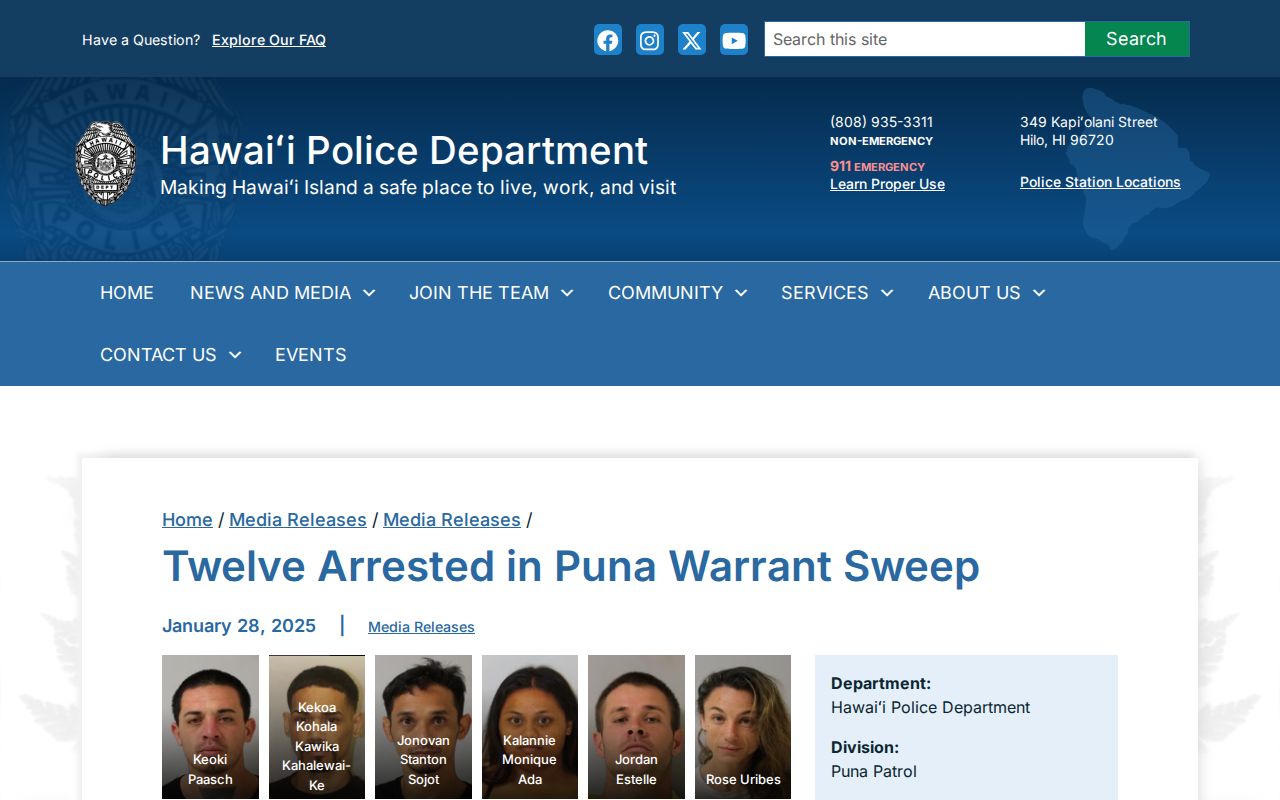
The release backs only its aggregate operation facts. Never treat it as a current Hawaii County roster of people or warrants.
A July 2024 sweep hit East Hawaiʻi. HPD ran it with the U.S. Marshals Hawaii Fugitive Task Force and DOCARE. That is real agency coordination. No named roster comes out of it. The official East Hawaiʻi operation release stays a dated summary, and its totals are not today's active-warrant count for Hawaii County.
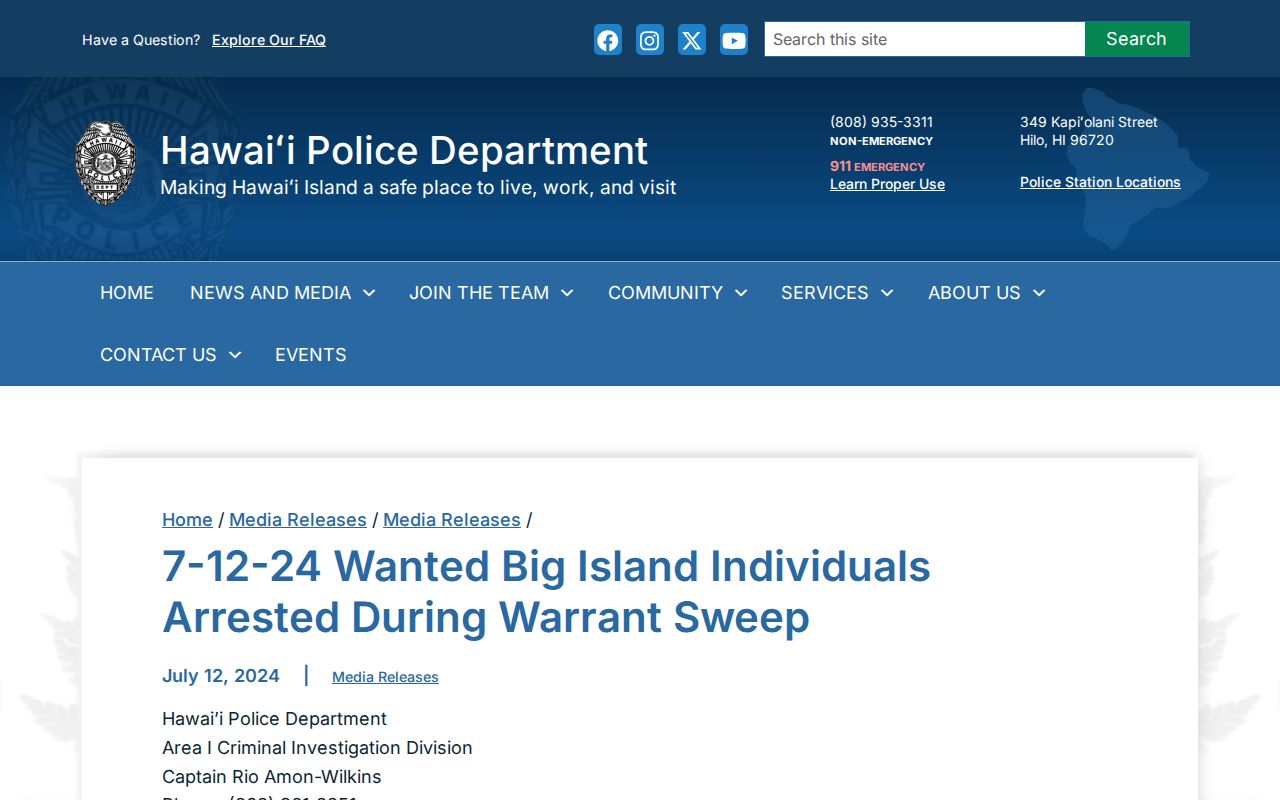
These releases show multi-agency warrant service. Names, photographs, and allegations stay out of the picture. Older items are history, not benchmarks. A June 1999 HPD page counted 4,849 outstanding warrants in Hawaii County at the time. That figure is far too old now. It cannot describe the current county total. The 2025 Puna and 2024 East Hawaiʻi reports are narrower operation summaries, so keep every number tied to its date and scope before any sweep statistic or historical count gets mistaken for a live inventory.
Most-Wanted Lists and Warrant Roundups
HPD and Hawaii Island Crime Stoppers have posted curated most-wanted notices and public-safety programming. A curated notice highlights selected matters. It is not the full court ledger. HPD also publishes occasional sweep summaries. No office here runs a countywide Hawaii County amnesty, safe-surrender event, or warrant-clearing holiday.
Key Point: The official Hawaii Island Crime Stoppers program accepts anonymous tips and explains its reward process.
Official notices change and cover selected cases only. No names, photos, mugshots, or person-level allegations are republished here.
Crime Stoppers is a tip channel. It does not report case status. Someone with information about a selected notice can follow the official anonymous-tip instructions. A person checking on their own status should contact the court or counsel instead. Never approach someone featured in an official notice. Skip social-media copies whose date or source you cannot confirm, and let the official HPD page supply the proper Hawaii County context.
Requesting Hawaii County Warrant Records
When eCourt Kōkua runs thin on detail, Hawaii County warrant records start with a written request to the branch that holds the case. The neighbor-island request instructions ask for a clear case or citation ID, the document type, and a date. Be precise. Name the Third Circuit division, the case ID or citation, the document, and the approximate filing date. Do not send payment with the initial request. The Judiciary bills by invoice and requires the stated form of prepayment. Confidential records can need court approval first. Hilo and Kona Legal Documents Branches are the primary Circuit Court contacts, and District Court matters may route through Hilo, Kona, or Waimea/South Kohala. Confirm routing first. A quick call can spare you a long drive across Hawaii County, where the population centers sit far apart. For police files, a UIPA request to HPD should describe an existing police-held record, a date range, and the format you want. HRS Chapter 92F does not require HPD to create a new public list when no such compilation exists. Ask for segregable, redacted portions when protected material can be separated. Court dockets stay with the court, and police operational records stay with HPD, so a Hawaii County warrant request lands in the right office the first time.
Hawaiʻi Administrative Rules Chapter 2-71 governs administrative access for state and county agencies, including the notice rules OIP describes. Nothing there promises a warrant-related record within a fixed period. Privacy, active-investigation concerns, sealed court material, and other lawful limits can slow or block release. Ask for the non-exempt portion. Ask the agency to state its basis for withholding. An access dispute is separate from the underlying question of whether a Hawaii County court order remains active. Where the file sits matters too. Circuit-level adult criminal records route through the Legal Documents Branch, while District Court keeps misdemeanor, traffic, and county-ordinance matters, and Family Court adds its own confidentiality limits. The county mayor's office does not hold state-court warrants for Hawaii County, and a federal case belongs with the District of Hawaiʻi rather than the Third Circuit.
If Your Name Is on the List
Make sure the notice actually names you. Confirm the case ID and the issuing court, then call that court or a licensed attorney in Hawaii County for current instructions. Your options depend on the case. They may include a planned voluntary surrender, case-specific bail, a required appearance, or a motion to recall or quash the warrant. Filing the motion is not enough. The judge must grant it, and the order must be processed before the warrant clears.
Important: Consult a lawyer before surrendering or traveling; an unresolved warrant can lead to arrest during contact with law enforcement.
Bail and release terms in Hawaii County are set by the order itself. Some matters need a judge. Probation or conditional-release warrants can carry different terms. Read the signed order and use the official court contact rather than guessing. Never pay a caller who offers to remove a warrant. HPD has warned about scammers who spoof its identification, claim a missed court date, and demand gift cards, Bitcoin, Coinstar, or another urgent transfer. Hang up. Find the court or police number on your own. A real clerk can identify the case. That clerk can also explain the court's accepted process, and no caller can make a Hawaii County warrant disappear just because money moved through an unofficial channel. A license stopper is not a warrant. The eCourt code OLS marks a stopper that can block license issuance or renewal. It is not a public arrest-warrant record. Traffic outcomes turn on whether the matter is a crime, an infraction, or an appearance-required case, so ask the Traffic Violations Bureau or the issuing District Court which order controls. Paying an eligible citation through eTraffic does not by itself recall a separate bench warrant.
Hawaii County Case Status Is Not Warrant Status
ACTIVE does not mean "active warrant." In a Hawaii County docket, the Judiciary FAQ uses ACTIVE to say the case is ongoing. INACTIVE is different. It can cover a pending file awaiting a future event, even after a failure to appear, while CLOSEDJ and CLOSEDS mark different closure conditions, and none of these codes should be read apart from the docket.
- MRBW
- Motion to recall bench warrant. Check whether an order granted it.
- MQSH
- Motion to quash. Filing alone is not resolution.
- CBF
- Court bail forfeited. It does not confirm that a warrant is cleared.
- OSEL
- Order sealed or confidential, which can limit public access.
Start with the latest signed order. Pair it with direct confirmation from the Hawaii County court. That habit guards against two errors. A similar name can produce a false positive, and restricted records or timing gaps can produce a false negative, so a missing screen proves nothing about an active warrant. Family and juvenile files call for more restraint. The JJIS warrant summary lists fields like issue date, circuit, status, service date, and agency. Access to that system is not public access. A sealed order or an OSEL code can keep a document from ordinary view. When Hawaii County access is restricted, ask the court about lawful access. Do not infer status from a missing screen or hunt a copied roster elsewhere. The same caution fits HPD wanted notices. A notice serves public safety. It is not the island's full Hawaii County warrant inventory. It may concern more than an ordinary bench warrant, so follow official safety instructions, send tips only through HPD or Crime Stoppers, and never approach the person named. For your own case, return to the issuing court. That keeps the tip function apart from the legal task of confirming and resolving an order in Hawaii County.
No countywide amnesty, safe-surrender day, or no-arrest walk-in program exists in Hawaii County right now. Check current Judiciary and HPD notices anyway. An event can be announced at any time. Ordinary resolution in Hawaii County stays case-specific. It can take a scheduled appearance, a recall or quash motion, bail review, a surrender plan, or compliance with another order. The District Court recall form makes the point plainly. The court itself must act. Removal from a web page is not the legal event that clears an outstanding warrant. Keep good notes as you work. Save the case number, notice date, court division, and the name of the office you contacted. That record helps staff see what's unconfirmed. Helping a relative takes permission. Keep the inquiry on the official case, and don't build a private profile from docket fragments or copy values from a warrant form. Counsel can coordinate confirmation, an appearance, bail questions, and a surrender plan. That matters most when the only match is a shared name or an old Hawaii County news release. Run the official check again close to the time you'll act. Public dockets, protected systems, and orders update at different times. Save the latest order date, not just a search screen. If the answer stays unclear, ask a narrow question about the identified case and say what you don't know. A careful "unresolved" beats calling a Hawaii County warrant active or cleared from a code, a missing record, or a stale notice.